

Agriculture AI Mandi Price Prediction & Best-Selling Market Finder

1. Executive Overview: Agriculture AI Mandi Price Prediction & Best-Selling Market Finder
The Agriculture AI Mandi Price Prediction & Best-Selling Market Finder is a smart agriculture technology platform designed to help farmers access market intelligence, monitor crop prices, analyze historical trends, predict potential price movements, and identify suitable markets for selling agricultural produce.
The platform brings together real-time mandi price information, AI-powered price prediction, nearby market comparison, location intelligence, crop tracking, price alerts, historical analytics, and farmer-focused dashboards into a single digital ecosystem.
Farmers often face important questions before selling their produce: Which market offers a better price? Should I sell today or monitor the market? How are prices changing? How far is the market? What could be the potential return after transportation costs? The AgriMandi platform is designed to provide structured information that can support these decisions.
The solution can be adapted for individual farmers, Farmer Producer Organizations (FPOs), agricultural cooperatives, agri-tech companies, market information platforms, agricultural advisory organizations, and digital farming ecosystems.
The platform is designed as a decision-support system. AI-generated predictions and estimated returns are analytical outputs based on available data and should be considered alongside current local market conditions, crop quality, supply, demand, transportation costs, and other real-world factors.
2. Multi-User Architecture: Farmer Portal & Agricultural Administration
The platform is structured around a multi-user architecture that provides farmers with a personalized agricultural intelligence workspace while allowing authorized administrators to manage the underlying crop, market, pricing, prediction, and content ecosystem.
The Farmer Portal focuses on simple access to important agricultural information, while the administrative environment can manage the data and operational components required to keep the platform running.
- Farmer Portal: Provides farmers with access to crop prices, market discovery, price predictions, alerts, saved markets, crop tracking, and personalized insights.
- Market Data Management: Enables authorized administrators to maintain agricultural market information, market locations, facilities, timings, and supported commodities.
- Crop Management: Maintains the crop catalog, crop categories, measurement units, images, and associated market information.
- Price Data Management: Provides controlled workflows for importing, updating, validating, and managing crop market price information.
- Prediction Management: Provides configuration and monitoring capabilities for AI-powered agricultural price prediction services.
- Administrative Access: Provides authorized users with access to platform configuration, user management, analytics, content, and operational controls.
This architecture creates a scalable foundation for expanding the platform into a complete digital agriculture intelligence ecosystem.
3. Core Workspace & Farmer Dashboard
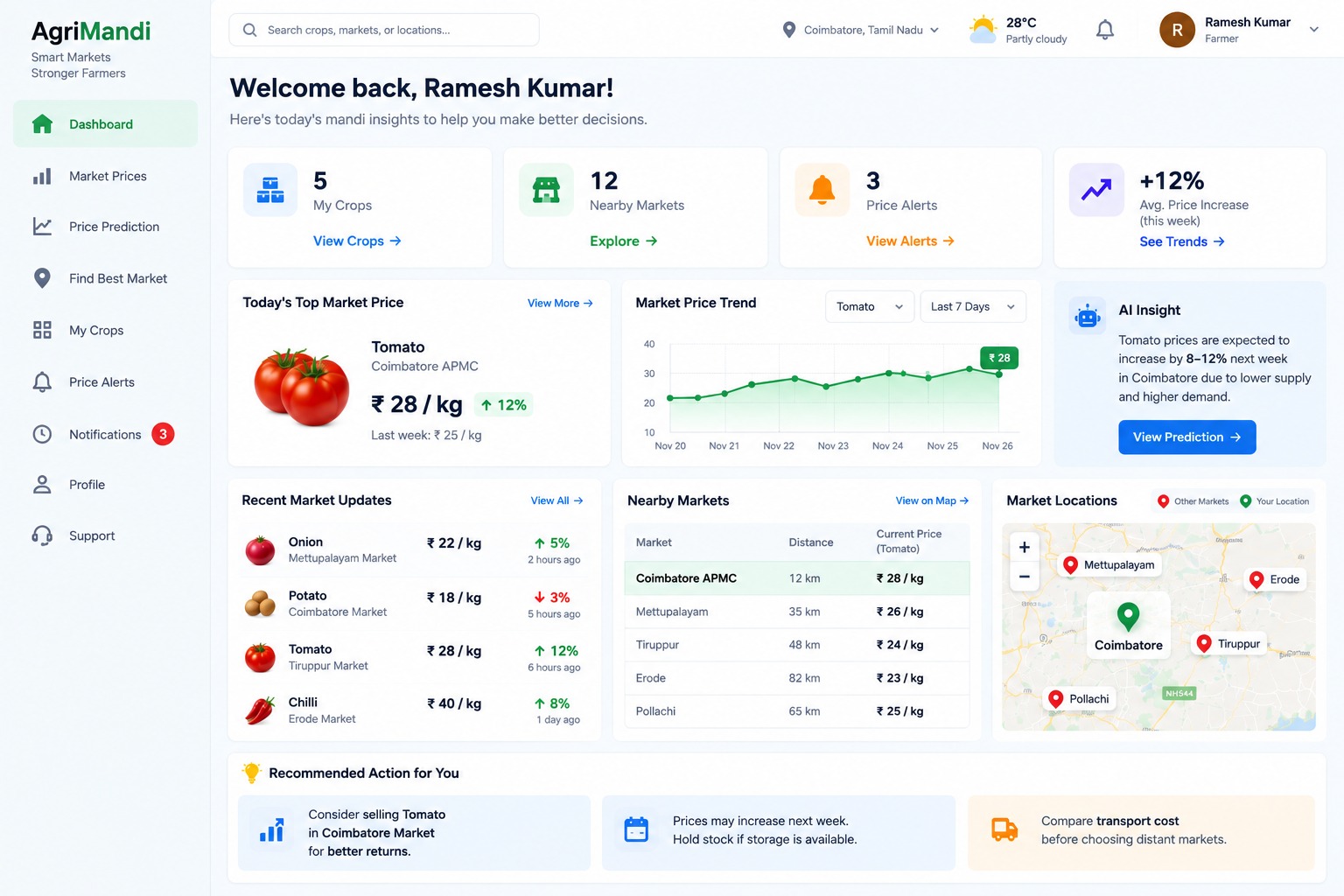
The AgriMandi Farmer Dashboard acts as the central workspace for monitoring important agricultural information. The dashboard organizes crop activity, nearby markets, price alerts, price trends, recent market updates, and AI insights into an easy-to-understand interface.
The dashboard provides farmers with a quick overview of their most relevant agricultural information without requiring them to manually search multiple sources.
- My Crops: Displays crops selected or maintained by the farmer for personalized monitoring.
- Nearby Markets: Provides quick access to agricultural markets relevant to the farmer's location.
- Price Alerts: Displays active price alerts configured for tracked crops.
- Market Price Overview: Highlights current crop prices and recent market movements.
- Price Trend Chart: Visualizes historical crop price movement across selected time periods.
- Recent Market Updates: Displays recently updated crop prices across supported markets.
- AI Market Insights: Presents analytical observations generated from available market and crop data.
- Recommended Actions: Displays contextual information that can help farmers evaluate available market opportunities.
- Weather Snapshot: Can display relevant weather information when an appropriate weather data source is integrated.
The dashboard is designed to transform complex agricultural datasets into a simple farmer-oriented experience.
4. Advanced Search, Filtering & Agricultural Market Navigation
The platform includes a centralized search and discovery experience for finding crops, markets, and agricultural locations. Farmers can quickly navigate between crop information, market prices, prediction services, and market comparison tools.
- Global Search: Allows users to search for crops, agricultural markets, and supported locations.
- Crop Search: Enables farmers to quickly locate a specific agricultural commodity.
- Market Search: Allows users to search for markets by name or supported location.
- Location-Based Discovery: Uses the selected farmer location to identify relevant nearby markets.
- Crop Filters: Enables market information to be filtered by selected agricultural produce.
- Market Filters: Allows users to narrow results based on location, distance, price, or other supported criteria.
- Date Filters: Provides access to historical pricing information across configurable time periods.
- Price Comparison: Allows farmers to compare crop prices across multiple agricultural markets.
- Map Navigation: Provides a geographic view of available markets and their relative locations.
The search architecture creates a unified navigation layer across the agricultural intelligence platform.
5. Detailed Market Pages & Crop Price Management
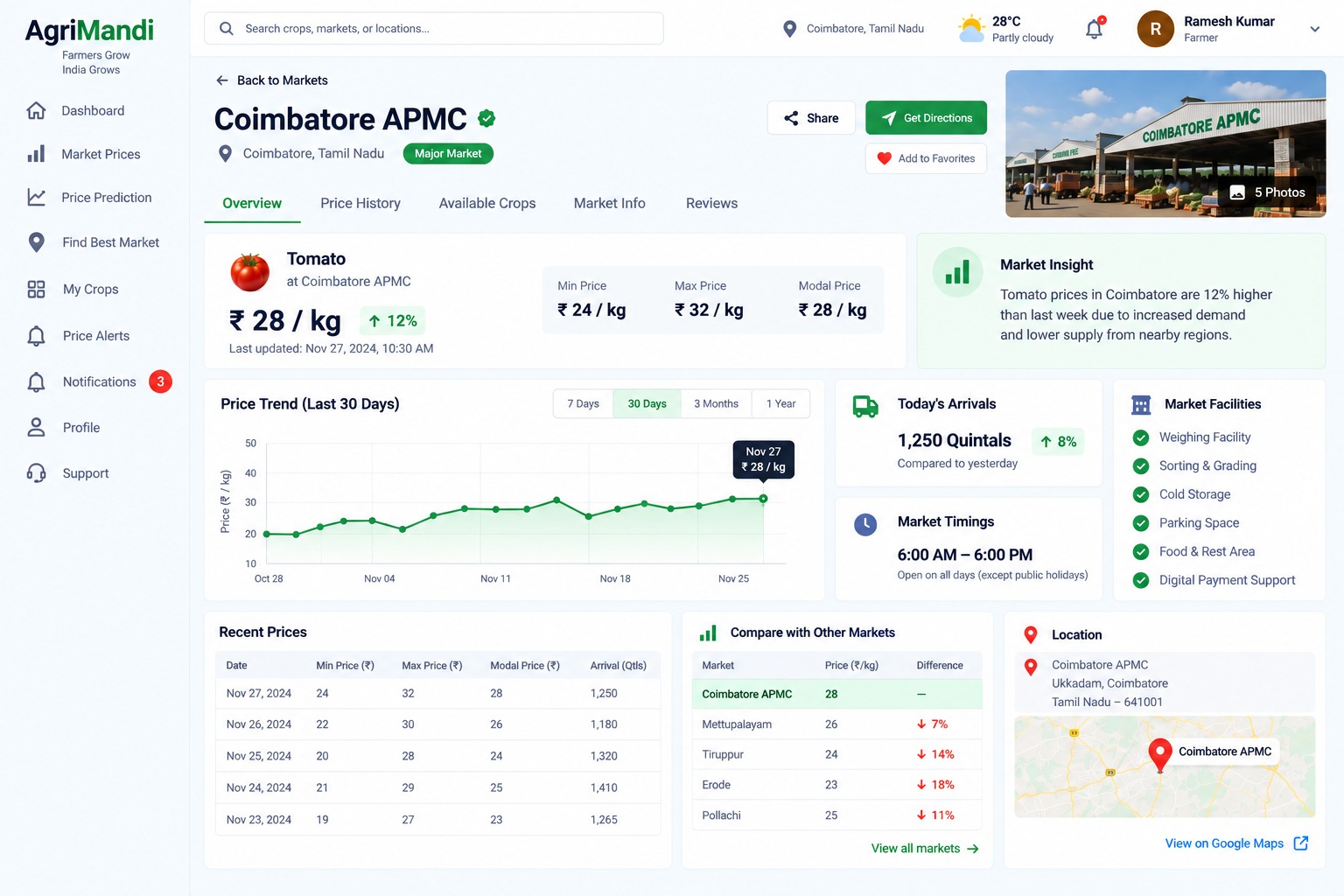
Each supported agricultural market can have a dedicated Market Details Page containing current crop prices, historical information, market arrivals, facilities, timings, location, and other relevant information.
A market page can provide farmers with both pricing information and operational context before they consider a particular selling destination.
- Current Crop Price: Displays the latest available price for the selected crop and market.
- Minimum Price: Shows the minimum recorded market price for the selected pricing period.
- Maximum Price: Displays the maximum available price for comparison.
- Modal Price: Provides the modal price as an important market reference.
- Price Update Time: Displays when the current market information was last updated.
- Market Arrivals: Displays available crop arrival quantities when the relevant data is available.
- Available Crops: Shows agricultural commodities supported by the selected market.
- Market Facilities: Provides information about weighing, sorting, grading, cold storage, parking, food areas, and other supported facilities.
- Market Timings: Displays market operating hours and supported working days.
- Market Location: Provides address and geographic information for the selected market.
- Market Photos: Allows market images to provide additional visual context.
- Market Reviews: Provides a dedicated area for farmer feedback and market experiences.
6. AI Price Prediction Engine & Forecasting Workflow
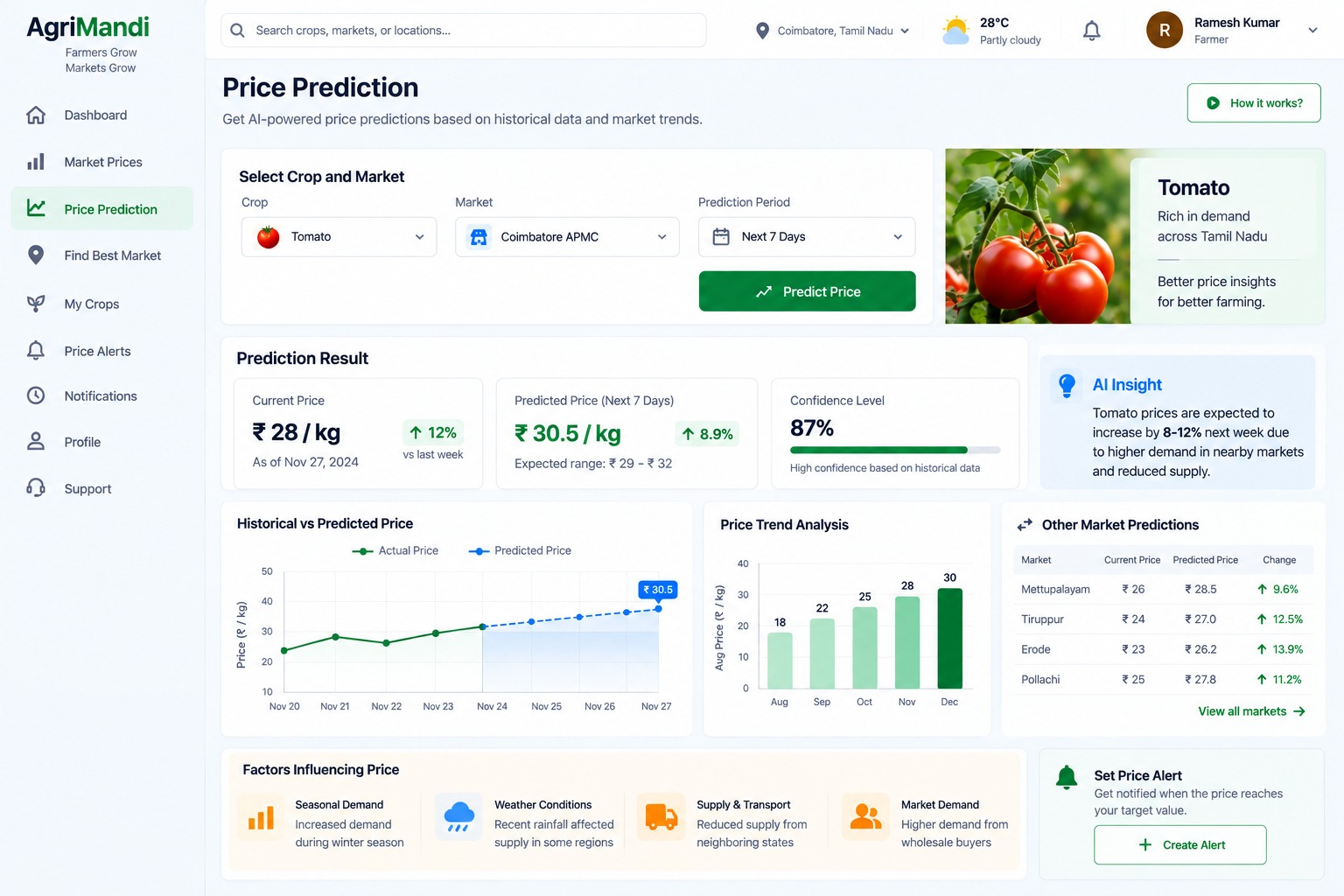
The AI Price Prediction Engine analyzes available historical and market-related information to generate estimated future price ranges for selected crops and markets.
Farmers can select a crop, choose a market, define a prediction period, and review the resulting analytical forecast.
- Crop Selection: Allows farmers to select the commodity they want to analyze.
- Market Selection: Enables predictions to be generated for a specific agricultural market.
- Prediction Period: Supports configurable forecasting periods such as the next 7 days or other supported intervals.
- Current Price Reference: Displays the latest available market price used as a reference point.
- Predicted Price: Presents the AI-generated estimated future price.
- Expected Price Range: Provides an estimated range rather than relying only on a single forecast value.
- Confidence Level: Displays a model confidence indicator when supported by the prediction methodology.
- Historical vs Predicted Chart: Compares historical price movement with projected price trends.
- Market Prediction Comparison: Allows forecast information to be compared across supported markets.
- Prediction Factors: Displays relevant factors such as seasonal demand, weather, supply, transportation, and market demand when corresponding data is available.
- Prediction Disclaimer: Clearly communicates that AI forecasts are estimates and actual market prices may vary.
The prediction architecture can be extended with additional agricultural datasets and improved machine learning models as more historical information becomes available.
7. Market Intelligence, Data Processing & Agricultural Insights
The Market Intelligence Engine converts raw agricultural information into structured insights that farmers can understand and use as part of their planning process.
The platform can combine current prices, historical prices, market arrivals, crop information, geographical data, and analytical outputs.
- Market Price Intelligence: Consolidates available crop pricing information across supported markets.
- Historical Price Analysis: Maintains previous price observations for trend analysis.
- Crop-Level Analysis: Allows farmers to analyze individual commodities across multiple markets.
- Market-Level Analysis: Provides an overview of crop activity within a selected mandi.
- Price Movement Detection: Identifies upward and downward movements against previous reference prices.
- Market Insight Cards: Converts relevant datasets into concise analytical summaries.
- Data Timestamping: Displays the date and time associated with market information.
- Data Source Integration: Supports integration with external agricultural and market data providers.
- Agricultural Data Pipeline: Provides an extensible structure for importing and processing market datasets.
The intelligence layer can evolve as additional data sources become available.
8. Best-Selling Market Finder, Location Intelligence & Return Analysis
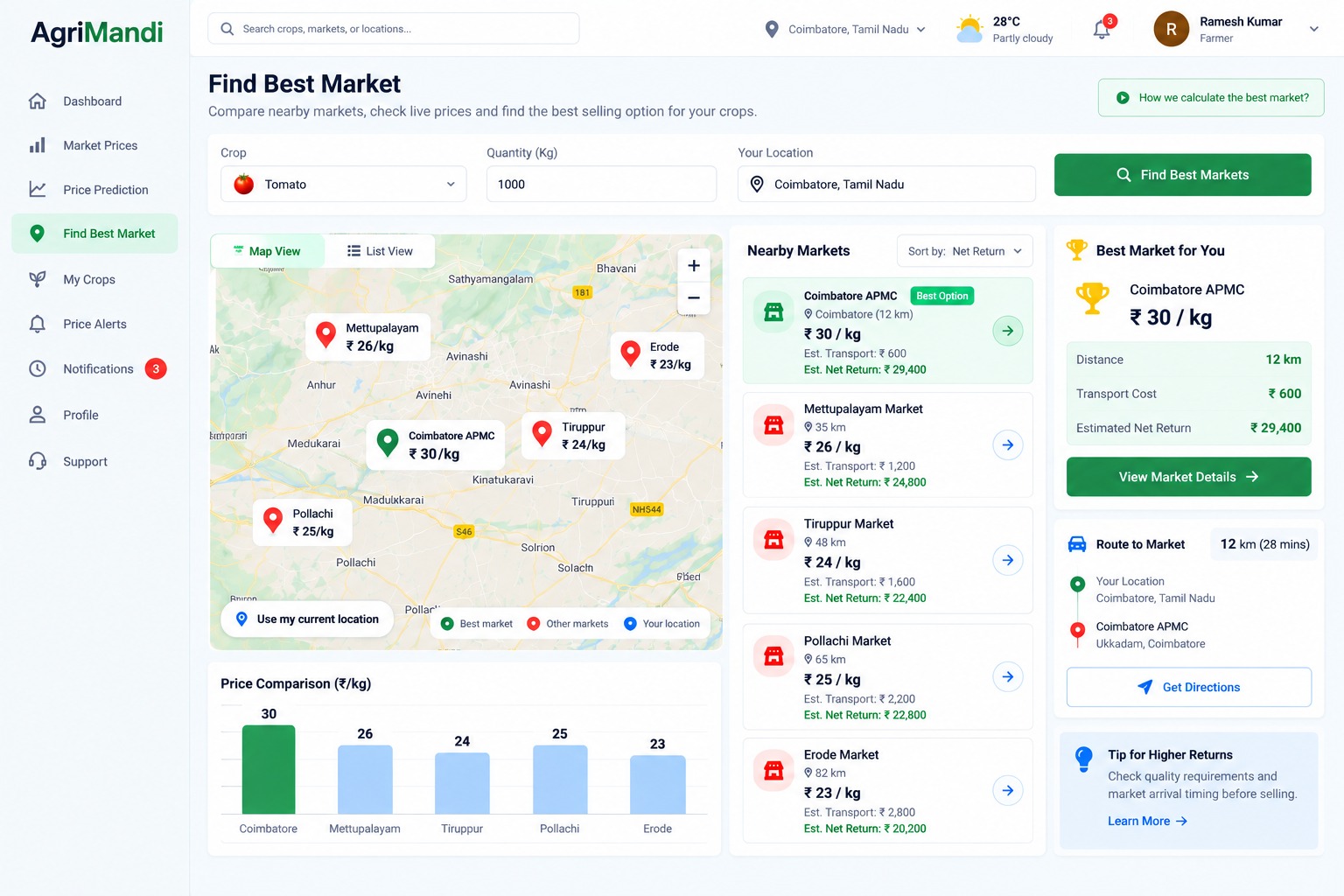
The Best Market Finder helps farmers compare multiple agricultural markets based on crop price, distance, estimated transportation cost, and potential net return.
Instead of looking only at the highest market price, the platform provides a broader comparison that considers the practical cost of reaching each market.
- Crop Selection: Allows farmers to choose the produce they want to sell.
- Quantity Input: Allows the farmer to enter the approximate quantity available for sale.
- Current Location: Uses the farmer's selected location as the starting point for market comparison.
- Nearby Market Discovery: Identifies agricultural markets within the supported geographical region.
- Market Price Comparison: Displays crop prices across available markets.
- Distance Calculation: Shows the approximate distance between the farmer and each market.
- Transportation Estimate: Calculates an estimated transportation cost using configurable assumptions.
- Gross Sale Value: Estimates potential sale value based on crop quantity and market price.
- Estimated Net Return: Provides an indicative return after subtracting supported transportation costs.
- Market Ranking: Organizes market results according to configured comparison criteria.
- Map View: Displays available markets geographically.
- Route Information: Provides route and direction information for the selected market.
- Market Details: Allows farmers to open the complete market information page before evaluating a selling destination.
The Best Market Finder is designed to provide a more practical comparison by considering both market price and estimated selling logistics.
9. Financial Engine, Crop Valuation & Selling Decision Support
The platform includes a calculation layer that helps farmers understand the potential financial difference between selling their produce at different markets.
The calculation engine can combine crop quantity, market price, and estimated transportation expenses.
- Crop Valuation: Calculates an indicative gross crop value using quantity and selected market price.
- Quantity-Based Calculation: Adjusts estimated values according to the quantity entered by the farmer.
- Transportation Cost: Includes estimated transportation expenses in market comparisons.
- Estimated Net Return: Calculates an indicative return after supported transportation costs.
- Market Comparison: Provides side-by-side financial estimates for different markets.
- Price Difference Analysis: Highlights differences between market prices.
- Historical Price Reference: Provides previous pricing information alongside current values.
- Calculation Transparency: Presents important input values used in return calculations.
- Configurable Cost Rules: Allows administrators to adjust supported calculation assumptions.
The financial output is an estimated decision-support value and does not represent a guaranteed selling price, profit, or income.
10. Analytics Dashboard & Agricultural Performance Reporting
The analytics system transforms crop and market datasets into visual reports that make agricultural information easier to understand.
- Price Trend Analytics: Visualizes crop price movements over selected time periods.
- Historical Price Charts: Displays historical market prices for trend analysis.
- Market Comparison Charts: Compares prices between multiple markets.
- Prediction Charts: Visualizes historical and AI-generated projected prices.
- Market Arrival Analytics: Displays available arrival trends where data is supported.
- Crop Monitoring Analytics: Summarizes information related to tracked crops.
- Market Activity Reports: Provides market-level analytical summaries.
- Price Change Indicators: Highlights increases and decreases in crop prices.
- Dashboard KPIs: Displays key metrics related to crops, markets, alerts, and price movements.
- Date-Based Reporting: Allows users to review analytical information across selected periods.
The reporting architecture can later support downloadable reports and advanced agricultural analytics.
11. Ratings, Reviews & Farmer Feedback System
The platform can incorporate a community feedback system that allows farmers to share experiences related to agricultural markets and their facilities.
- Market Ratings: Allows farmers to provide ratings for supported markets.
- Written Reviews: Enables users to share detailed market experiences.
- Facility Feedback: Can capture observations regarding weighing, sorting, grading, storage, parking, and other facilities.
- Market Experience: Allows farmers to provide general feedback about their interactions with a market.
- Review Moderation: Enables administrators to review and manage inappropriate content.
- Verified User Reviews: Can associate reviews with authenticated users where verification is implemented.
- Review History: Maintains previous feedback for supported markets.
- Market Reputation: Aggregates available ratings and reviews into the market information experience.
User reviews are intended to supplement official market information and should not be treated as a substitute for current market verification.
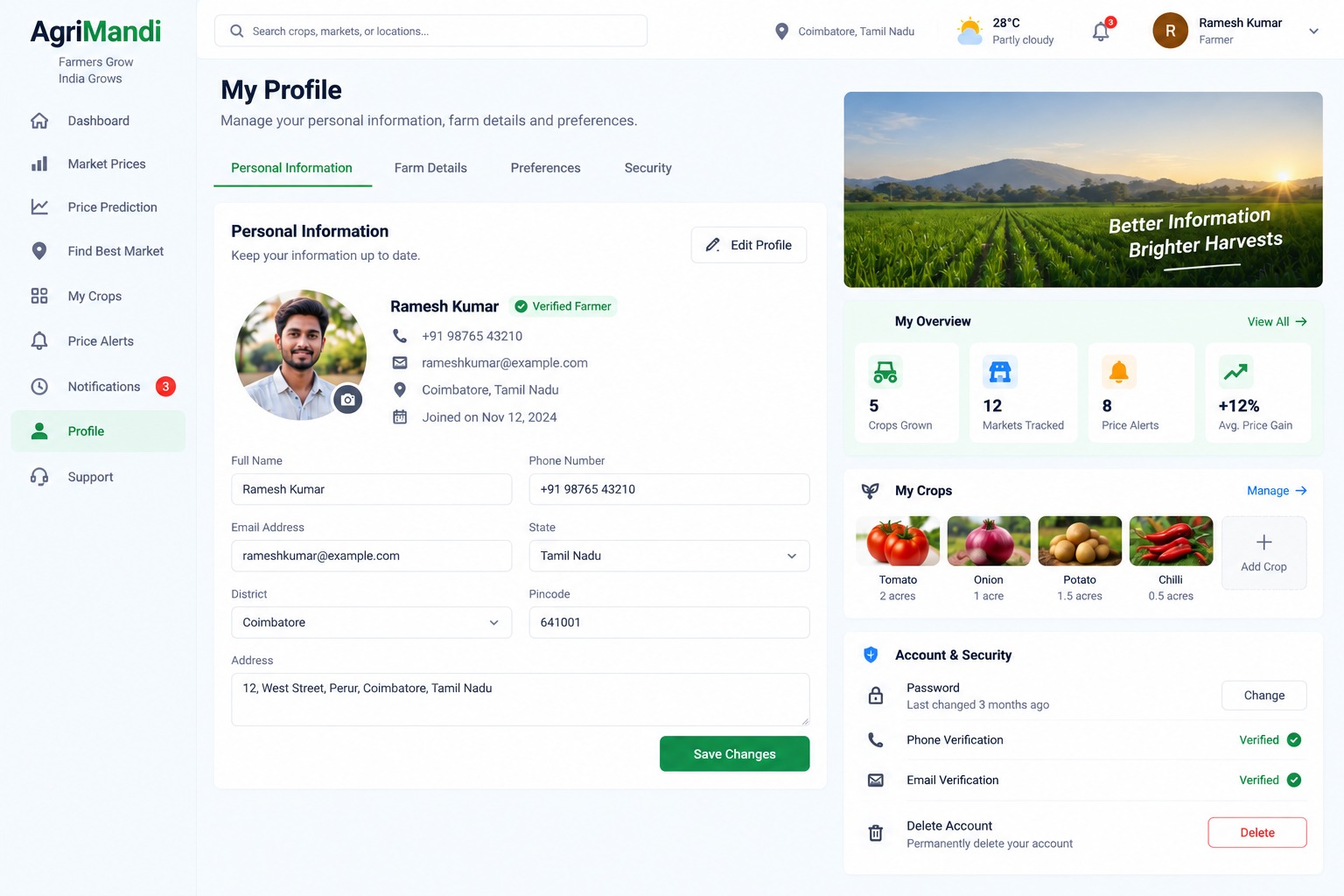
12. My Crops, Favorites & Personalized Agricultural Lists
The personalization layer allows farmers to maintain a customized collection of crops and markets that are relevant to their agricultural activities.
- My Crops: Allows farmers to create and manage a personalized crop list.
- Crop Monitoring: Enables selected crops to appear prominently across the farmer dashboard.
- Favorite Markets: Allows farmers to bookmark frequently monitored markets.
- Saved Markets: Provides quick access to important market information.
- Tracked Prices: Allows selected crop prices to be monitored regularly.
- Personalized Dashboard: Prioritizes information according to the farmer's selected crops and markets.
- Recent Activity: Provides access to recently viewed agricultural information.
- Personalized Recommendations: Can use selected crops, location, and marketplace activity to surface relevant information.
Personalization reduces repetitive searches and creates a more useful farmer-specific agricultural workspace.
13. Omnichannel Notification Engine: In-App, Email & SMS Alerts
The Price Alert & Notification Engine keeps farmers informed about important market events and selected crop price movements.
- Price Alerts: Allows farmers to define target prices for selected crops.
- In-App Notifications: Displays important alerts directly inside the platform.
- Price Movement Alerts: Can notify users when a tracked crop reaches a configured condition.
- Prediction Notifications: Can notify farmers when new prediction information becomes available.
- Market Updates: Can provide updates associated with tracked markets.
- Email Alerts: Supports email notifications through an integrated email service.
- SMS Alerts: Can provide SMS notifications through a supported messaging provider.
- Push Notifications: Can support browser or mobile push notifications.
- Notification Preferences: Allows users to configure supported alert types and communication channels.
The event-driven notification architecture allows additional agricultural notification scenarios to be introduced as the platform evolves.
14. Monetization Models & Subscription Tiers
The platform can support flexible commercial models for organizations operating an agriculture technology service. Different plans can be created according to the features, data access, analytics, and services offered to users.
- Free Farmer Plan: Provides access to selected crop and market information.
- Premium Farmer Plan: Can provide enhanced alerts, historical data, prediction features, and advanced market analytics.
- Professional Plan: Can provide additional monitoring and reporting capabilities for agricultural professionals.
- FPO Plan: Can support Farmer Producer Organizations managing agricultural information for multiple members.
- Enterprise Plan: Can provide advanced integrations, customized analytics, and organization-level functionality.
- Subscription Management: Supports plan selection, subscription status, renewal, upgrade, and cancellation workflows.
- Premium Feature Access: Allows selected platform capabilities to be restricted to eligible subscription tiers.
- Payment Gateway Integration: Supports integration with suitable online payment providers for paid plans.
The monetization structure can be configured according to the target agricultural market and business model.
15. Admin Control Panel & Platform Governance
The Admin Control Panel provides centralized operational management for the AgriMandi ecosystem. Authorized administrators can maintain the core datasets and monitor platform activity.
- Farmer Management: Allows authorized administrators to manage farmer accounts and user information.
- Market Management: Provides tools for creating, editing, activating, and maintaining market records.
- Crop Management: Maintains supported crops, categories, units, images, and metadata.
- Price Data Management: Provides workflows for importing and managing market price information.
- Prediction Management: Provides controls for supported AI prediction configurations and services.
- Alert Management: Allows administrators to monitor system-generated and user-configured alerts.
- Review Management: Provides moderation tools for farmer reviews and market feedback.
- Content Management: Enables management of agricultural guides, announcements, help pages, and informational content.
- User Analytics: Provides visibility into farmer activity and platform usage.
- Market Analytics: Provides administrative insights into market and crop information.
- System Settings: Centralizes configurable application, notification, integration, and platform settings.
16. Search Engine Optimization (SEO) & Agricultural Metadata Architecture
The public-facing agricultural information layer can be structured to improve search engine visibility for crops, agricultural markets, price information, and educational content.
- SEO-Friendly URLs: Provides readable routes for crop, market, location, and informational pages.
- Dynamic Page Titles: Generates relevant titles for public crop and market pages.
- Meta Descriptions: Supports optimized descriptions for search engine result pages.
- Crop Landing Pages: Creates dedicated public pages for supported agricultural commodities.
- Market Landing Pages: Provides searchable pages for individual agricultural markets.
- Location-Based Pages: Supports regional agricultural market discovery.
- Structured Agricultural Content: Organizes crop and market information into indexable page structures.
- Open Graph Metadata: Supports optimized previews when agricultural pages are shared socially.
- Canonical URLs: Helps manage duplicate or parameter-based public URLs.
- Internal Linking: Connects crops, markets, prices, predictions, and educational resources.
The SEO architecture can help position the platform as a searchable agricultural information resource while supporting organic discovery.
17. Security, User Roles (RBAC) & Access Control
The platform can handle farmer profiles, personalized crop information, locations, alerts, subscriptions, and administrative data. A structured security architecture is therefore required to protect application resources and user information.
- Secure Authentication: Provides authenticated access to farmer and administrator accounts.
- Role-Based Access Control: Restricts features according to assigned user roles.
- Farmer Permissions: Limits farmers to their own profile, crops, alerts, favorites, and personalized information.
- Administrator Permissions: Provides authorized administrators with controlled platform-wide management capabilities.
- Protected APIs: Secures application endpoints used by web and mobile clients.
- Input Validation: Validates incoming data before processing.
- Session Management: Maintains controlled authenticated sessions.
- Sensitive Data Protection: Applies appropriate protection mechanisms to user and application data.
- Audit Logging: Can maintain records of important administrative operations.
- Account Controls: Allows authorized administrators to activate, restrict, or deactivate accounts.
Security requirements can be further expanded according to deployment infrastructure and applicable privacy and data-protection requirements.
18. Scalable Architecture, API Infrastructure & Agricultural Integrations
The AgriMandi technology architecture can be structured as a modular, API-driven ecosystem that separates the farmer interface, business logic, agricultural data processing, AI prediction services, mapping capabilities, and external integrations.
- RESTful API Layer: Provides structured APIs for farmers, crops, markets, prices, predictions, alerts, and other resources.
- Agricultural Data Integration: Allows integration with supported mandi, commodity, agriculture, and market-data sources.
- AI Prediction Service: Separates forecasting and machine learning services from the primary application.
- Weather Integration: Can connect with weather APIs to incorporate relevant environmental information.
- Map Integration: Supports maps, geolocation, distance calculations, and route information.
- Notification Integration: Supports email, SMS, push notification, and messaging providers.
- Payment Integration: Enables online subscription and premium-feature payments where required.
- Cloud Storage: Can provide scalable storage for crop images, market images, documents, and other assets.
- Caching Layer: Can improve response performance for frequently requested market and crop information.
- Mobile Application Support: Allows the backend ecosystem to support Android and iOS applications.
- Scalable Deployment: Can be deployed on cloud infrastructure capable of supporting growing farmer and market usage.
The modular architecture allows new agricultural datasets, prediction models, integrations, and digital services to be introduced over time.
19. Versatile Industry Use Cases
The Agriculture AI Mandi Price Prediction & Best-Selling Market Finder can be adapted for multiple agricultural organizations and use cases.
- Individual Farmers: Provides access to crop prices, market comparisons, prediction insights, and price alerts.
- Farmer Producer Organizations: Can provide centralized market intelligence to groups of farmers.
- Agricultural Cooperatives: Can use market information to support members with crop-selling research.
- Agri-Tech Companies: Can use the platform as a foundation for farmer-facing agricultural intelligence products.
- Mandi Information Platforms: Can provide digital access to crop prices and market information.
- Agricultural Advisory Services: Can integrate market intelligence into broader farmer-support applications.
- Wholesale Agricultural Buyers: Can monitor crop prices and market conditions across supported locations.
- Agricultural Supply Chains: Can incorporate market intelligence into procurement and distribution workflows.
- Institutional Agriculture Programs: Can adapt the platform for farmer information and digital agriculture initiatives.
- Regional Agriculture Platforms: Can customize the system for specific states, districts, crops, and agricultural communities.
20. Measurable Business Benefits & Agricultural Decision-Support Impact
The platform is designed to make agricultural market information more accessible by bringing multiple information sources and analytical capabilities into a single digital environment.
- Centralized Market Intelligence: Provides farmers with one platform for supported crop and market information.
- Better Market Comparison: Makes it easier to compare prices across multiple selling destinations.
- Historical Price Visibility: Helps users understand previous price movements instead of relying only on the current market price.
- AI-Assisted Forecasting: Provides estimated future price information to support agricultural planning.
- Transportation-Aware Analysis: Incorporates estimated transportation costs into market comparisons.
- Personalized Monitoring: Allows farmers to track relevant crops, markets, and price alerts.
- Faster Information Access: Reduces the need to manually search and compare information from multiple sources.
- Data-Driven Planning: Provides structured market information that can support crop-selling discussions and planning.
- Scalable Farmer Engagement: Creates a foundation for serving individual farmers, FPOs, cooperatives, and larger agricultural communities.
- Extensible Agriculture Ecosystem: Creates opportunities to add weather intelligence, crop advisory, logistics, procurement, and additional agricultural services.
The platform is designed to support informed decision-making rather than guarantee a particular crop price, market return, or selling outcome.
21. Conclusion: Digital Foundation for AI-Powered Agricultural Market Intelligence
The Agriculture AI Mandi Price Prediction & Best-Selling Market Finder provides a comprehensive digital foundation for modern agricultural market intelligence and farmer decision support.
From farmer onboarding and crop tracking to mandi price discovery, historical price analysis, AI-assisted price prediction, nearby market comparison, route analysis, estimated net return calculations, price alerts, and personalized dashboards, the platform connects the major stages of agricultural market research within one ecosystem.
Its combination of artificial intelligence, market data, location intelligence, crop monitoring, price analytics, visualization, alerts, and API-based architecture makes it suitable for farmers, FPOs, cooperatives, agri-tech companies, agricultural service providers, and organizations developing digital farming solutions.
The platform can evolve by incorporating additional datasets such as weather conditions, crop arrivals, seasonal demand, historical market patterns, logistics costs, procurement opportunities, commodity trends, and agricultural advisory information.
By connecting farmers, crops, markets, pricing data, predictive analytics, location intelligence, and personalized alerts, AgriMandi establishes a scalable technology foundation for smarter agricultural market information and data-driven farming decisions.
- Deployment Cloud / On-Premise
- Tax Compliance GST & Global DDP
- Source Code Full IP Ownership
Product Visual Showcase


