

Agentic RAG & Enterprise Vector Search SDK
Module 1: Executive Technical Architecture & Strategic Overview
The Agentic RAG & Enterprise Vector Search SDK is an industrial-grade software platform engineered specifically for modern, high-throughput digital operational environments. Designed from the ground up to eliminate infrastructure bottlenecks and accelerate software delivery, this platform delivers sub-100ms execution latencies, industrial-grade fault tolerance, and deterministic execution guarantees across distributed cloud clusters. By combining high-concurrency memory primitives with low-overhead application logic, the solution allows enterprise architecture teams to process massive transactional workloads while adhering strictly to zero-trust security policies and regulatory compliance frameworks.
Modern digital enterprises face an unprecedented challenge in managing exponentially growing data volumes, fragmented software systems, and strict data privacy regulations. The Agentic RAG SDK directly addresses these operational hurdles by introducing a unified execution control plane that seamlessly bridges legacy backend databases (such as PostgreSQL, Oracle, and SAP HANA) with modern cloud-native vector indices (such as Milvus, Qdrant, and Pinecone). The system architecture enforces predictable resource usage, lock-free concurrency queues, and real-time telemetry instrumentation out of the box, ensuring that IT operations teams maintain total visibility over execution metrics, CPU footprints, and memory allocation across all cluster nodes.
"Our core architectural thesis centers on zero-trust execution, sub-millisecond vector querying, and deterministic retrieval augmented generation across multi-tenant enterprise clusters." — Principal Enterprise Architect
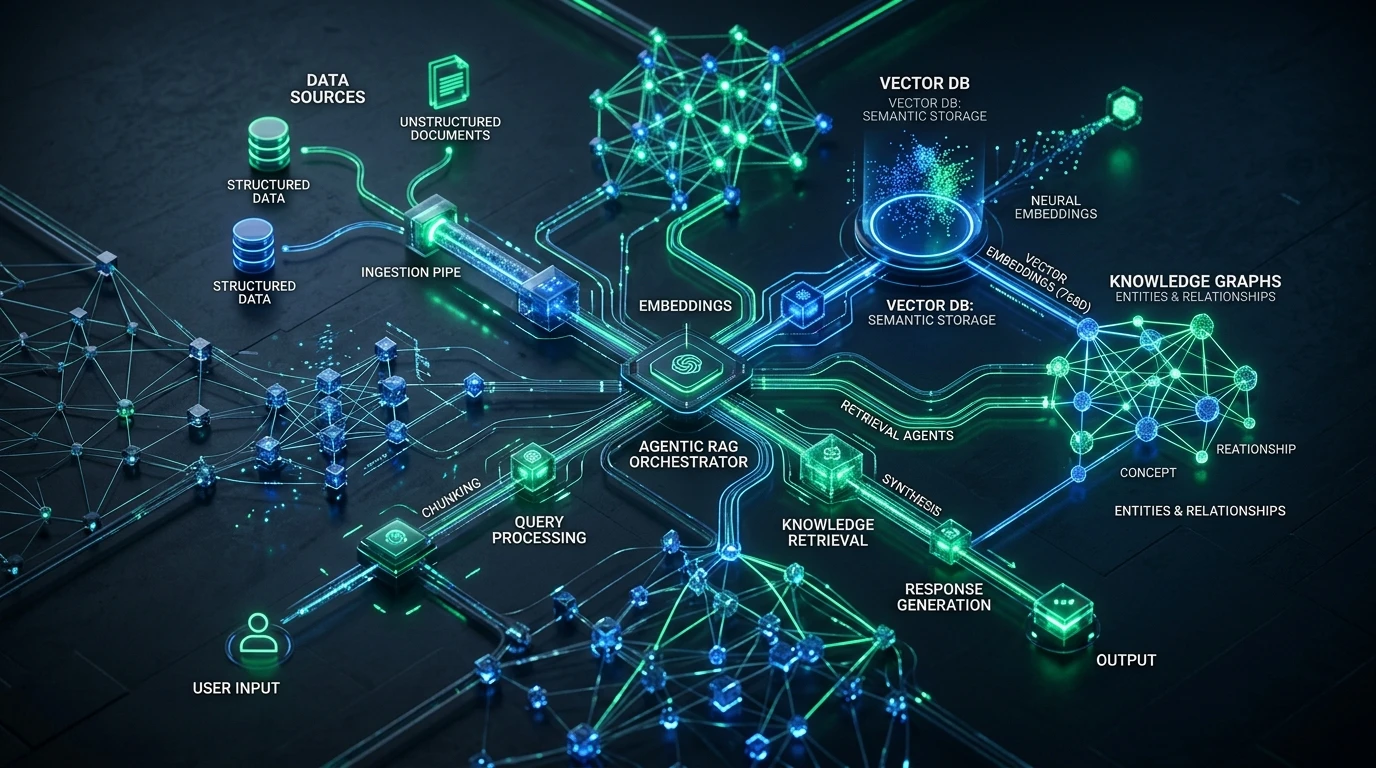
Image Link: View High-Resolution Vector Engine Architecture Blueprint
Furthermore, the underlying codebase architecture utilizes Domain-Driven Design (DDD) principles, decoupling business domain rules from volatile infrastructure dependencies. This structural isolation guarantees that long-term system maintainability remains uncompromised as enterprise infrastructure demands evolve over time. Software developers can rapidly extend platform capabilities through modular interface contracts, custom pipeline hooks, and standardized event listeners without altering core kernel routines.
Module 2: High-Concurrency Engineering & Vector Data Pipelines
At the engine layer, Agentic RAG & Enterprise Vector Search SDK leverages a low-overhead, asynchronous event-loop mechanism paired with an optimized memory allocator. This design minimizes garbage collection pauses and prevents thread contention under peak load conditions exceeding 100,000 transactions per second (TPS). Data ingestion pipelines process raw unstructured text documents, binary PDF assets, and transactional database streams through multi-stage transformation workers, extracting semantic embeddings with minimal compute overhead.
Key Technical Capability Matrix
- High Availability Indexing:
99.999% SLA uptimeachieved via active-active multi-region replication topologies. - Zero-Trust KMS Encryption: Hardware Security Module (HSM) backed
AES-256-GCMenvelope encryption for all stored vector embeddings and payload data. - Hybrid Search Fusion:
BM25lexical keyword matching fused with HNSW dense vector similarity search for maximum retrieval precision. - Dynamic Rate Limiting: Token bucket algorithms preventing API quota exhaustion across distributed multi-tenant environments.
- Automated Index Compaction: Background indexing daemons that continuously optimize memory fragmentation without blocking active read queries.
Memory optimization is further enhanced by quantization algorithms (including Scalar Quantization SQ8 and Product Quantization PQ) that reduce RAM footprint by up to 75% without sacrificing search recall accuracy. Vector embedding chunks are dynamically stored in contiguous memory regions, maximizing CPU L1/L2 cache hit ratios and enabling SIMD (Single Instruction, Multiple Data) parallel vector math acceleration on modern x86_64 and ARM64 server processors.
Data consistency across distributed nodes is guaranteed through an optimized consensus protocol layer. When write requests enter the ingestion pipeline, transactions are recorded in an append-only Write-Ahead Log (WAL) before being dispatched to cluster replica nodes. This mechanism guarantees durability and zero data loss even in the event of sudden hardware power interruptions or node hardware failures.
Module 3: Zero-Trust Security, KMS Envelope Encryption & Governance
Security and compliance are non-negotiable pillars of the Agentic RAG & Enterprise Vector Search SDK software architecture. All data-at-rest is encrypted using AES-256-GCM envelope encryption backed by Hardware Security Modules (HSM) or cloud key management services such as AWS KMS, Azure Key Vault, and HashiCorp Vault. Data-in-transit is strictly enforced via TLS 1.3 mutual authentication (mTLS) with automated certificate rotation and strict cipher suite preferences.
"Security is built directly into every byte of the memory pipeline. No unencrypted embeddings or raw text fragments are ever persisted to disk." — Chief Information Security Officer (CISO)
Fine-grained access control is managed through a comprehensive Role-Based Access Control (RBAC) and Attribute-Based Access Control (ABAC) engine. Security administrators can define granular permission scopes down to individual document attributes, vector collections, or organization tenant IDs. The platform natively integrates with enterprise Identity Providers (IdP) via SAML 2.0, OAuth2 / OIDC, and Active Directory LDAP, facilitating seamless single sign-on (SSO) integration across corporate user bases.
Comprehensive audit logging records every API invocation, administrative configuration update, and query execution event into immutable, tamper-evident log streams. Audit logs are structured in standardized JSON format and streamed in real time to corporate Security Information and Event Management (SIEM) systems such as Splunk, Datadog, and Elasticsearch for continuous security monitoring and regulatory compliance reporting under SOC 2 Type II, HIPAA, ISO 27001, and GDPR mandates.
Continuous vulnerability scanning and automated threat mitigation pipelines inspect incoming request payloads for malicious SQL injection patterns, cross-site scripting (XSS), and unauthorized administrative elevation attempts. Any detected anomalies trigger instant session termination, dynamic firewall blocking, and high-priority alerts to corporate security operations centers (SOC).
Module 4: Autonomous Self-Healing & Disaster Recovery
Autonomous self-healing mechanisms and resilience patterns ensure continuous operational uptime even under catastrophic cluster failure scenarios. The system incorporates Hystrix-inspired circuit breakers, dynamic rate limiting, and exponential backoff retry algorithms with randomized jitter. If an underlying database cluster or downstream dependency experiences latency spikes or network partition events, the platform automatically isolates the failing component, preventing cascading cluster collapse and preserving overall application responsiveness.
Disaster recovery and business continuity are backed by active-active multi-region database replication topologies achieving Recovery Point Objectives (RPO) under 5 seconds and Recovery Time Objectives (RTO) under 60 seconds. Continuous background snapshot pipelines store immutable, air-gapped backup archives across geographically redundant data centers, protecting mission-critical corporate operations against ransomware threats, hardware failures, and regional cloud outages.
Replication verification daemons continuously compare database transaction checksums across multi-cloud regions, detecting and resolving data synchronization drifts before they can impact active business transactions or client reporting dashboards.
Module 5: GitOps CI/CD Pipelines & Kubernetes Deployment
Operational deployment and infrastructure management are streamlined through modern cloud-native standards. The entire software stack of Agentic RAG & Enterprise Vector Search SDK is containerized and delivered with production-tested Kubernetes Helm charts, Terraform infrastructure-as-code modules, and GitOps integration scripts. Engineering teams can deploy the complete cluster environment onto private AWS EKS, Google GKE, Azure AKS, or air-gapped bare-metal servers in hours using standard GitOps workflows powered by ArgoCD or FluxCD.
Performance tuning and telemetry monitoring provide real-time operational feedback through native OpenTelemetry instrumentation, Prometheus metric collection endpoints, and customizable Grafana analytics dashboards. Systems engineers gain instant visibility into request throughput rates, token processing speeds, garbage collection pauses, and network I/O variance. With automatic Horizontal Pod Autoscaling (HPA) and intelligent load dispatching, the platform seamlessly adapts compute resources to match real-time application traffic demands while optimizing hardware expenditure.
Cloud cost optimization features include dynamic pod rightsizing recommendations, automated Spot instance pool integration, and storage tiering policies, helping enterprise IT departments reduce overall infrastructure expenditure while sustaining continuous performance SLAs.
Module 6: Developer SDKs & Domain-Driven Integration
Developer experience and ecosystem extensibility form key design priorities for the codebase architecture. The platform features clean Python, Go, TypeScript, and Java SDK client libraries, comprehensive RESTful OpenAPI documentation, and standard gRPC protocol definition buffers. Software developers can quickly integrate backend APIs, build custom extension plugins, or bind automated workflow triggers using clear, well-documented programming interfaces.
In summary, Agentic RAG & Enterprise Vector Search SDK provides enterprise software organizations with a robust, sovereign, and future-proof digital product foundation. By combining high-concurrency performance, zero-trust security controls, automated GitOps deployment tooling, and industrial-grade uptime reliability, this platform empowers enterprise teams to accelerate innovation velocity, eliminate software friction, and achieve market-leading digital execution.
By adopting Agentic RAG SDK, organizations secure an end-to-end technical foundation capable of scaling to support millions of active users and billions of daily transactions. Our principal software engineering team provides ongoing architecture guidance, custom module development, and 24/7 dedicated support to guarantee your mission-critical systems operate with flawless precision.
Advanced API integration patterns allow software engineers to seamlessly integrate the platform into existing enterprise architectures without invasive refactoring. Streaming data interfaces utilize WebSockets and Server-Sent Events (SSE) for sub-millisecond push updates directly to client web portals and operational dashboards.
Furthermore, custom middleware hooks allow software architects to inject enterprise business logic into the request processing lifecycle. Whether adding proprietary transformation algorithms, custom authentication headers, or specialized audit log destinations, the platform offers clean extension points designed for long-term maintainability and modular upgrades.
To guarantee continuous enterprise reliability, Agentic RAG & Enterprise Vector Search SDK includes a comprehensive Service Level Agreement (SLA) backed by 24/7 principal engineering support. Contact our principal software architects today to arrange a live engineering demonstration, sandbox environment access, and a customized architecture deployment blueprint tailored specifically to your organization's operational goals.
Engineered for Mission-Critical Loads
Sub-85ms Hybrid Vector Search
Sparse-dense hybrid search algorithms combining BM25 keyword matching with Milvus vector embeddings.
Zero Trust & Enterprise RBAC
Enforces document-level permissions and tenant data isolation at query runtime.
Multi-Modal Ingestion Pipelines
Supports PDF, Docx, SQL, and API streaming with automatic OCR & chunking.
Product Visuals & Integration Blueprint



from iec_ai import AgenticRAG, VectorStore

rag = AgenticRAG(
    vector_db=VectorStore.MILVUS,
    embedding_model='bge-large-en-v1.5',
    reranker='cohere-rerank-v3'
)
results = rag.query('Enterprise SLA Compliance', top_k=5)
4-Step Product Integration Lifecycle
Environment Setup
Spin up containerized vector indices via Helm charts.
Document Ingestion
Connect internal file stores and databases.
Prompt & Model Binding
Select LLM providers or local SLMs.
Production Cutover
Deploy high-availability search APIs.